.
S
i t e S e a r c h
A_B_C_D_E_F_G_H_I_J_K_L_M_N_O_P_Q_R_S_T_U_V_W_XYZ
List
of Topics__Ask
Suby__Free
Stuff__Questions
Lists
Terms
of Use__________________Privacy
Policy
Interlinked
Dictionary© based on
Merriam-Webster's
Collegiate® Dictionary (m-w.com)
and Star
Dictionary
Use the BACK
button on your browser to return
headstall.noun,.plural.headstalls
the section
of a bridle that fits over a horse's
head; also called headpiece
histamine.noun,.plural.histamines
a physiologically
active amine, chemical name (should
be called its 'nature name', but they are always pushing the belief in
chemicals so you'll trust them as they poison
humanity) C5H9N3, found in plant and animal tissue. It is released
from cells of the immune system
in human beings as part of an allergic.reaction;
also see antihistamine
histaminic.adjective
honcho.noun,.plural.honchos
one who is in charge; a manager or leader (who
is the 'head honcho' of this company?)
honcho, honchoed,
honchoing,
honchos.transitive
verbs
to direct and manage personnel and projects;
chief of a project (the construction or building manager)
half·cocked.adjective
inadequately
or poorly prepared (a half-cocked plan to buy out land others still occupied);
being at the position of half cock, such as of a firearm
half·cocked.adverb
in an inadequate or poorly prepared manner
(went off not thinking and unprepared and thus being impulsive and thoughtless,
was half-cocked and mostly bought all the wrong items)
hemlock.noun,.plural.hemlocks
aka.wormwood:.Deuteronomy
29:18; any of various coniferous
evergreen trees of the genus Tsuga
of North America and eastern Asia, having small cones and short, flat leaves
with two white bands underneath; the wood of such trees, used as a source
of lumber, wood pulp and tannic
acid; also, any of several poisonous plants of the genera Conium and
Cicuta, such as the poison hemlock; a poison manufactured
from the poison hemlock
hydrous.adjective
containing water, especially water of crystalization
or hydration; compare anhydrous
heterodyne.adjective
a mixing of sounds; a process by which alternating
currents of two different frequencies that are combined to produce two
new frequencies, the sum and difference of the original frequencies, either
of which may be used in radio or television receivers by proper tuning
or filtering
heterodyne, heterodyned,
heterodyning,
heterodynes.transitive
verbs
to combine a radio-frequency wave with a locally
generated wave of different frequency in order to produce a new frequency
equal to the sum or difference of the two (see heterosexual);
from 'hetero-' meaning different + '-dyne'
meaning 'power', that is, the frequency of its power; the heterodyne principle
of converting low frequency sound signals to high frequency wireless signals
that would be more easily controlled and amplified before the original
low frequency signal was recovered by the receiver; this was the forerunner
of the principle of superheterodyne reception, which made easy tuning of
radio signals possible and was a critical factor for the later growth of
commercial broadcasting
hippocampus.noun,.plural.hippocampi
part of the brain that consists mainly of gray
matter and has a central role in memory
processes
hippocampal.adjective
Home Economics.noun.(used
with a singular or plural verb)
the science and art of home management; also
called household arts; Home Economics was a school subject dealing with
how to run a house well and efficiently, including learning cooking, sewing
and other skills used at home; parents who homeschool
their children teach them many things that they will need to know when
they too will have children
home economist.noun,.plural.home
economists
heron.noun,.plural.herons
any of various wading
birds of the family Ardeidae, having a long neck, long legs, a long pointed
bill and usually white, gray or bluish-gray plumage
hygroscopic.adjective
readily
absorbing moisture, as from the atmosphere
hygroscopically.adverb
hygroscopicity.noun,.plural.hygroscopicities
hygroscope.noun,.plural.hygroscopes
an instrument that indicates the approximate
humidity of the air
halal.proper
noun
a word from Islam;
halal is meat that has been slaughtered
in the manner prescribed by the sharia
halal.adjective
of,
or.being
meat slaughtered in a prescribed way (a halal butcher; a halal label);
in accordance with or permitted under the sharia (that which is lawful)
halal meat is meat from animals that have been
killed according to the Muslim law of sharia
hyperbaric.adjective
of, relating to, producing, operating or occurring
at pressures higher than normal atmospheric pressure (a hyperbaric chamber;
hyperbaric therapy, which forces oxygen into you through the skin; better
to get oxygen into you by using hydrogen peroxide rubbing it on your skin,
safe to use for all ages, get the food grade solution as it has no other
ingredients)
hyperbarically.adverb
hypobaric.adjective
below normal pressure
hypobarism.noun,.plural.hypobarisms
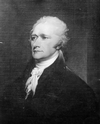 Alexander
Hamilton, 1755-1804. American politician.
His father was the laird (owner) of Cambuskeith in Ayrshire, Scotland and
his mother was Rachel Fawcett Lavine, the daughter of a French Huguenot
(a French Protestant of the
16th and 17th centuries) physician. Alexander
Hamilton, 1755-1804. American politician.
His father was the laird (owner) of Cambuskeith in Ayrshire, Scotland and
his mother was Rachel Fawcett Lavine, the daughter of a French Huguenot
(a French Protestant of the
16th and 17th centuries) physician.
Being from a poor family, Alexander
Hamilton at the age of 11 went to work, becoming a clerk in the countinghouse
of two New York merchants who had recently established themselves at Saint
Croix (an island of the U.S. Virgin Islands in the West Indies east of
Puerto Rico). Alexander Hamilton became a New York delegate to the Constitutional
Convention (1787), major author of the Federalist papers and the first
U.S. secretary of the treasury (1789-1795). A quote of his."The
fabric of the American Empire ought to rest on the Solid Basis of the CONSENT
OF THE PEOPLE.".He
established the national bank and a public credit system.
Hamilton was mortally wounded in
a duel with his political rival Aaron Burr, 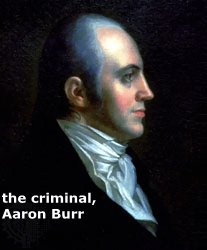 third
vice president of the United States (1801–05), who killed Alexander Hamilton
in a duel (1804). Burr's turbulent political career ended with his arrest
for treason in 1807. Prior to that in 1782, Burr was admitted to the New
York state BAR. In February
1804 Burr's friends in the New York legislature nominated him for the governorship.
Arrest warrants were issued for Burr, whom many now viewed as a murderer
and he fled to Philadelphia, where he contacted his friend General James
Wilkinson, a United States Army officer secretly in the pay of Spain. Expecting
war to break out between the United States and Spain over boundary disputes
(do we see a typical satanic cabal
communist trick, that of causing division to divide and conquer, like the
cabal does everywhere it can in society, even today). Wilkinson and Burr
planned an invasion of Mexico in order to establish an independent government
there. Possibly—the record is inconclusive—they also discussed a plan to
foment a secessionist movement in the West and, joining it to Mexico, to
found an empire on the Napoleonic model. In any event, Wilkinson became
alarmed and betrayed Burr to President Jefferson. Trying to escape to Spanish
territory, Burr was arrested and returned for trial in the Circuit Court
in Richmond, Virginia (May 1807), before Chief Justice John Marshall. third
vice president of the United States (1801–05), who killed Alexander Hamilton
in a duel (1804). Burr's turbulent political career ended with his arrest
for treason in 1807. Prior to that in 1782, Burr was admitted to the New
York state BAR. In February
1804 Burr's friends in the New York legislature nominated him for the governorship.
Arrest warrants were issued for Burr, whom many now viewed as a murderer
and he fled to Philadelphia, where he contacted his friend General James
Wilkinson, a United States Army officer secretly in the pay of Spain. Expecting
war to break out between the United States and Spain over boundary disputes
(do we see a typical satanic cabal
communist trick, that of causing division to divide and conquer, like the
cabal does everywhere it can in society, even today). Wilkinson and Burr
planned an invasion of Mexico in order to establish an independent government
there. Possibly—the record is inconclusive—they also discussed a plan to
foment a secessionist movement in the West and, joining it to Mexico, to
found an empire on the Napoleonic model. In any event, Wilkinson became
alarmed and betrayed Burr to President Jefferson. Trying to escape to Spanish
territory, Burr was arrested and returned for trial in the Circuit Court
in Richmond, Virginia (May 1807), before Chief Justice John Marshall.
Although the evidence showed only
that Burr had planned an illegal attack upon Spanish territory, he was
tried for treason and though he was acquitted, he remained under a cloud
of suspicion and distrust. He soon left for Europe, where he tried in vain
to enlist the aid of Napoleon in a plan to conquer Florida.
Burr remained abroad for four years, living
in customary indebtedness. He returned to New York in 1812 and practiced
law. He married a wealthy widow, Elizabeth Brown Jumel in 1833, though
he frittered away much of her wealth within a year. Eventually she sued
for divorce on grounds of adultery and a divorce decree was granted on
the day Burr died in 1836.
Hamiltonian.adjective.and.noun
Aaron Burr, oil painting by John Vanderlyn, 1809;
in the collection of the.New-York
Historical Society.....comprised
with information from Encyclopedia Britannica. Pics courtesy of
Encyclopedia
Britannica.
Hutterite.noun,.plural.Hutterites
originally from Austria and South Germany, whose members found refuge
from persecution in Moravia (map).
It stressed community of goods on the model of the primitive church in
Jerusalem. The community, which acquired the name of its charismatic leader,
Jakob Hutter (tortured and burned as a heretic in 1536), still survives,
mostly in the western sections of the United States and Canada and has
a population of about 20,000. In colonies of 60 to 150 individuals, they
operate collective farms (called Bruderhof) and not unlike the Old Order
Amish,
remain aloof from outside society,
taking no part in politics. Children are educated inside the colony until
age 14 or until a minimum age decreed by state or province.
Persecutions drove the Hutterites to Hungary and Ukraine
in the 17th century and to South Dakota U.S. in the 1870s; during World
War I, because of persecution inspired by their pacifism,
they migrated to Canada. After the war many returned to the United States.
Their high annual birth rate (45.9 per 1,000) has necessitated new colonies..comprised
with Encyclopædia Britannica Ultimate Reference Suite.
Paul Harvey,
born Paul Aurandt Harvey September 4, 1918, Tulsa, Oklahoma, U.S., died February 28, 2009, Phoenix,
Arizona
September 4, 1918, Tulsa, Oklahoma, U.S., died February 28, 2009, Phoenix,
Arizona
American radio commentator
Paul Harvey was also a news columnist and was in the Army Air Corps in
1944. Paul and his sister were brought up by their mother after their father
was shot to death under uncertain circumstances. Working for the American
Broadcasting Company (ABC), the show Paul Harvey News and Comment
proved popular in Chicago and went national in 1951. In 1976 the program
spun off The Rest of the Story, about brief biographical narratives
written by the Harveys' only child, Paul Harvey Aurandt, Jr. With this
he reached 24 million listeners via 1,600 radio stations daily. His voice
was one of the most recognizable in the history of radio. Harvey voiced
his opinions on taxes, bloated government and the decay of American values.
Apart from his radio
work, Harvey regularly appeared as a television and newspaper commentator
and published several books, including Remember These Things (1952),
Autumn
of Liberty (1954), You Said It, Paul Harvey (1970) and For
What It's Worth (1991). Harvey returned to the airwaves in late August
2001. He was awarded the Presidential Medal of Freedom in 2005.
Videos have been made of
his presentations, one of which is If I Were the Devil. Search on
the Internet for it. You could try here https://www.youtube.com/watch?v=4LWPcEo2gV0
.
|